

When you ask a development agency to build your website, at some point they will say something like "we will use MERN" or "Laravel would suit this better." If you are not a developer, that can sound like a foreign language. And it matters more than most business owners realize, because the technology behind your website affects its speed, its cost, how easily it can grow, and how hard it will be to maintain two years from now.
This guide explains what a tech stack actually is, compares the options that most Mohali and Punjab businesses run into, and gives you a simple way to judge whether the stack your developer suggests is the right one for you.
A tech stack is the set of tools and languages used to build and run a website or web application. Think of it like the ingredients and kitchen equipment in a restaurant. The same dish can be cooked in different kitchens, but the setup affects how fast the food comes out, how many people you can serve, and how easy it is to change the menu later.
Most stacks have three layers. The front end is what visitors see and click. The back end is the engine that handles logins, orders, forms, and business rules. The database stores your information, such as customers, products, and bookings. A full stack developer works across all three, which is why choosing the stack is usually part of their job. If you want a wider view of the role, our post on how AI is transforming full stack web development explains how developers work today.
There are dozens of combinations, but a handful cover most business projects. Here is an honest look at each.
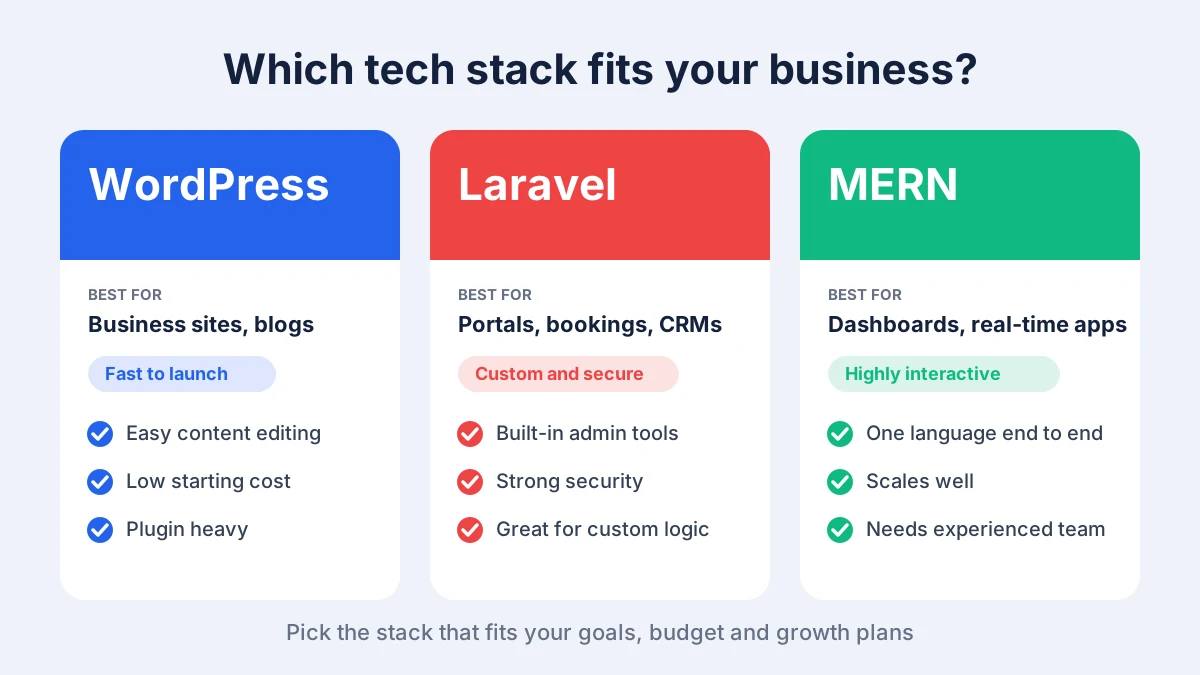
WordPress is a content management system built on PHP and MySQL. It is quick to set up, has thousands of themes and plugins, and lets non-technical staff update content on their own. It suits business websites, blogs, portfolios, and small online stores. The trade-off is that too many plugins can slow the site down and create security gaps, and highly custom features can get messy.
Laravel is a popular PHP framework for building custom web applications. It has strong built-in tools for user accounts, security, databases, and admin panels, which makes it a good middle path when WordPress is too limited but you do not need something extremely complex. It works well for booking systems, CRMs, portals, and custom business software.
MERN uses JavaScript across the whole project, from the screen to the server. It is well suited to fast, interactive applications such as dashboards, marketplaces, social platforms, and tools with lots of real-time updates. Teams like it because one language covers everything. It needs a more experienced team and more planning than a simple brochure site.
Next.js builds on React and is popular for websites that need to be very fast and search-friendly while still having app-like features. It is a strong option for content-heavy sites, e-commerce, and modern marketing websites, provided the team has the right experience.
If your main goal is to sell products online quickly, a hosted store platform may be the smartest choice. You pay monthly fees and accept some limits, but you avoid building a store from scratch.
No stack is the best in every situation. These questions usually point to the right answer faster than any technical debate.
Here is how this usually plays out in real projects.
If you are not yet sure what kind of website your business needs, start with our guide on web development in 2026 and then come back to this checklist.
Before you approve a stack, ask these questions in your next meeting:
Clear, honest answers are a good sign. Vague answers or heavy jargon are a warning.
For most small businesses, WordPress or a lightweight custom build is enough. The best choice depends on whether you need simple content pages or custom features such as bookings and customer accounts.
Neither is better in every case. MERN is strong for highly interactive applications, while Laravel is excellent for structured business applications and custom portals. The right pick depends on your project and your team.
Yes, but it usually means rebuilding large parts of the website, which costs time and money. That is why it is worth choosing carefully at the start.
It can. Speed, mobile performance, clean code, and how pages are rendered all influence search visibility. A well-built site on almost any modern stack can rank well, while a slow or poorly structured one will struggle.
Ask them to explain the reasons in plain language and compare it with your goals, budget, and growth plans. A trustworthy team will be happy to do that.
The right tech stack is not the most fashionable one. It is the one that fits what your business needs today and can grow with you tomorrow. Start with your goals, be honest about your budget and timeline, and ask your developers to explain their choices clearly.
If you are planning a new website or thinking about upgrading an old one, the team at Alien Web Solutions can look at your requirements and recommend a stack that makes sense for your business, not just the one that is easiest for us to build. Get in touch and tell us about your project.