

A few years ago, building a web application meant long hours of writing boilerplate code, searching for answers on forums, and fixing the same small bugs again and again. Today, a developer can describe a feature in plain language and get a working draft in seconds. That shift is changing how websites and web apps get built, and it is changing what clients can expect from a development team.
But is AI replacing full stack developers? Not really. It is changing their daily work, speeding up routine tasks, and raising the bar for what a good developer needs to know. In this guide, we look at where AI is making a real difference across the full stack, where it still falls short, and what this means for businesses in Mohali and across Punjab.
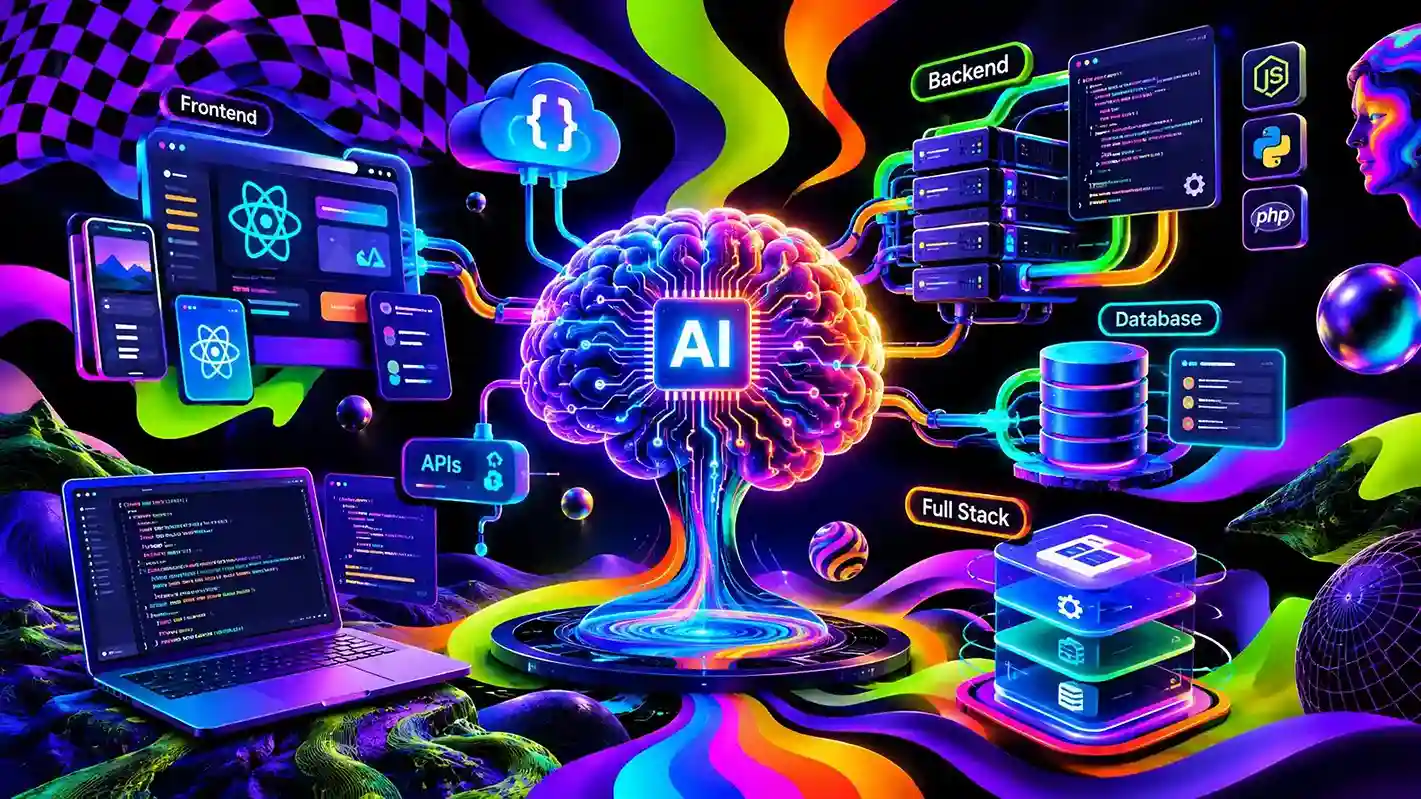
A full stack developer works on both sides of a web application. On the front end, they build what users see and interact with: layouts, forms, menus, and animations. On the back end, they handle what happens behind the scenes: databases, servers, APIs, user logins, and business logic. They also take care of testing, deployment, and ongoing maintenance.
That is a wide range of skills, which is exactly why AI tools are so useful here. Almost every layer of the stack has repetitive work that AI can help with.
AI coding assistants such as GitHub Copilot and Cursor suggest code as developers type, generate functions from a short description, and fill in repetitive patterns. Setting up a login system, a contact form, or a basic CRUD module used to take hours. With AI support, the first working version can take a fraction of that time.
On the front end, AI can turn a rough sketch or a written description into a starting layout with HTML, CSS, and component code. Developers still refine the result, but they no longer start from a blank page. This is especially helpful for landing pages, dashboards, and admin panels.
AI tools can draft database schemas, write queries, and suggest API structures. They are also useful for explaining unfamiliar code, which makes it easier to work on older projects that have little documentation.
Instead of searching through error messages for an hour, developers can paste the problem into an AI assistant and get likely causes and fixes. AI can also scan code for common mistakes, security gaps, and performance issues before a human reviewer even looks at it.
Writing test cases is important but often skipped because it is tedious. AI can generate unit tests and edge cases quickly, which helps teams ship more reliable software without adding days to the schedule.
Documentation is usually the first thing to be forgotten. AI can write clear comments, README files, and API documentation from existing code. On the deployment side, it can help with configuration files, build scripts, and monitoring setups.
AI is not only changing how websites are built. It is also becoming part of what they offer. More businesses now want features such as:
Adding these features means full stack developers now also need to know how to connect AI services through APIs, manage data safely, and design the experience so that it actually helps users.
The excitement around AI can hide its limits. Businesses that expect a tool to build a complete, secure, scalable application on its own are usually disappointed.
As routine coding gets faster, the value of a developer moves toward thinking rather than typing. The strongest full stack developers today spend more time on:
Developers who learn to work with AI tools are becoming much more productive. Those who ignore them risk falling behind. The skill is not just using the tool, but knowing when to trust it and when to question it.
For growing businesses, the biggest benefit of AI-assisted development is speed and value. Projects that once took months can reach a first working version much sooner, and clients can see progress earlier and give feedback sooner. Costs for repetitive work can come down, which leaves more budget for design, strategy, and testing.
At the same time, the market is filling up with quick, low-quality websites that were assembled with little thought. If you are choosing a development partner, here are some questions worth asking:
A good agency uses AI to work faster while keeping human judgment at the center. That combination is what separates a website that merely goes live from one that actually helps your business grow.
Unlikely in the near future. AI speeds up routine coding, but planning, architecture, security, and problem solving still need experienced people. The role is changing rather than disappearing.
It can reduce the time spent on repetitive tasks, which may lower costs for some parts of a project. However, good design, testing, and security still require skilled work, so quality projects remain a real investment.
Only after careful review and testing. AI can produce code with hidden bugs or security weaknesses, so a developer must check it before it goes live.
Yes. Chatbots, smart search, and personalized recommendations can be added to most modern websites through APIs. The right choice depends on your goals, your data, and your budget.
Strong fundamentals in front end, back end, databases, and security remain essential. On top of that, learning to use AI tools effectively and to connect AI services into applications is quickly becoming a standard skill.
AI is not the end of full stack development. It is the biggest change to how the work gets done in many years. It removes much of the repetitive effort, speeds up delivery, and makes new kinds of features possible. But the thinking, the responsibility, and the quality still come from people.
For businesses in Mohali and Punjab, the smartest move is to work with a team that embraces these tools without depending on them blindly.
If you are planning a new website, web application, or an upgrade to your existing platform, the team at Alien Web Solutions can help you build it with modern tools and sound engineering. Get in touch to discuss your project.