

Think about the last time you wanted to buy something or find a service. Did you only use Google? Maybe you checked Google Maps for reviews, watched a YouTube video to understand the product, looked at a brand's Instagram page, read what people said on Reddit, or simply asked an AI assistant for suggestions.
Your customers do the same thing. Search is no longer one box on one website. It is spread across many places, and your business needs to show up in the ones your customers actually use. That idea has a name: search everywhere optimization. In this guide, we explain it in simple words and give you a practical plan to start, even if you are a small team.
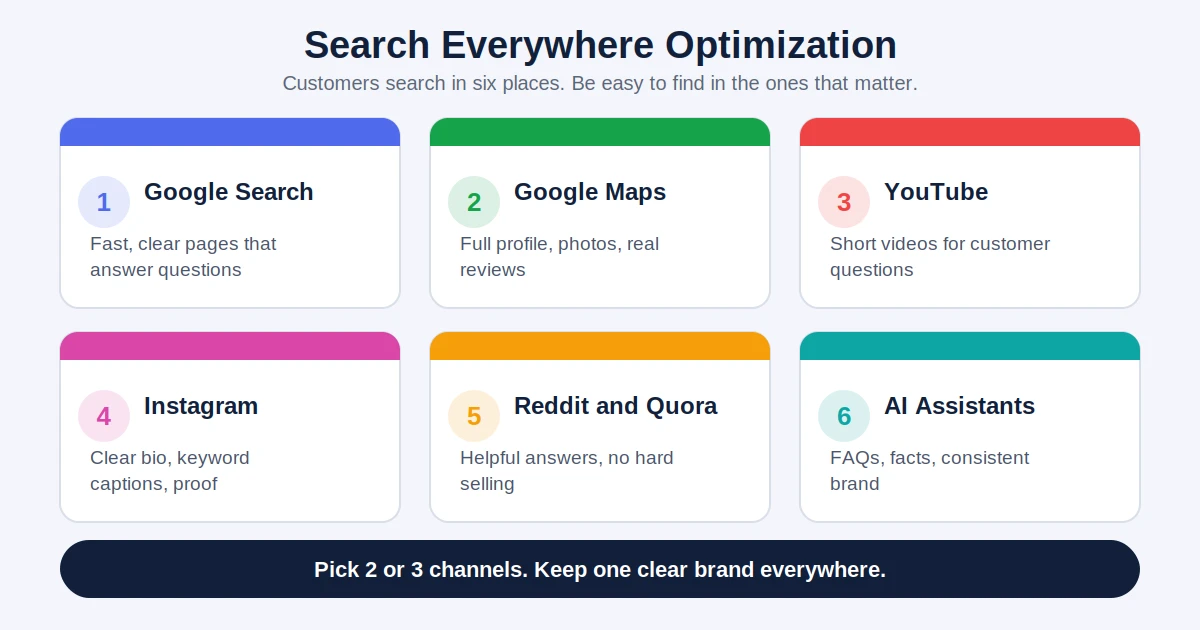
Traditional SEO focuses on ranking your website in Google. Search everywhere optimization (sometimes called SEvO) widens the goal: make your brand easy to find, understand, and trust on every platform where your customers look for answers.
It does not replace SEO. Your website and Google rankings still matter a great deal. It simply adds the other places where people discover businesses today, so you are not depending on a single channel.
Three changes are pushing this shift:
The message is simple: be present where the question is asked, not only where your website lives.
This is still the foundation. Make sure your website is fast, clear, and built around the questions your customers ask. For local businesses, Google Maps is just as important as the website. A complete, active Google Business Profile with correct details, fresh photos, and genuine reviews can bring in more calls than a ranking on page one.
What to do: Keep your business name, address, and phone number exactly the same everywhere. Reply to reviews. Add photos regularly. For a deeper look at this area, read our guide on how AI local search is changing local SEO.
YouTube is the second most useful place for many businesses because people go there to learn and to compare. A short video that answers one clear question can keep working for you for months.
What to do: Make videos around real customer questions, such as "how much does it cost" or "how to choose". Use a clear title, a helpful description, and captions. Add chapters for longer videos, and embed the video on the matching page of your website so both support each other. You do not need fancy equipment. A clear voice and useful content matter more.
People use social platforms to check whether a brand feels real. They look at your recent posts, your reels, your comments, and how you reply. Social search also reads your captions, hashtags, and profile text, so what you write there matters.
What to do: Write your bio with what you do and where you do it. Use plain keywords in captions instead of only emojis and slogans. Post proof of real work, such as results, behind-the-scenes, and customer stories. Our complete guide to social media optimization goes deeper into this.
Honest discussions often show up in search results because people trust real experiences. This is a place where hard selling backfires quickly, but helpful answers build quiet authority.
What to do: Join conversations where your customers ask questions, and give useful answers without pushing your service. Follow each community's rules. Over time, being the helpful expert people remember is worth far more than a link dropped in a hurry.
People now ask ChatGPT, Gemini, and Perplexity for recommendations. You cannot pay your way into those answers, but you can make your brand easier to find and cite. Clear, well-structured content, strong reviews, and a consistent brand presence across the web all help. We cover the details in our guide to optimizing content for AI search and in the comparison of GEO vs SEO.
What to do: Answer common questions directly on your pages, add an FAQ section, and keep your facts accurate and up to date.
Here is the part many businesses miss. Each platform is not a separate project. They all feed one picture of your brand. When your name, services, location, and message are the same across your website, Maps, social profiles, and videos, search engines and AI tools understand you better. That is the idea behind entity SEO, which we explain in our guide to entity SEO and knowledge graphs.
Trust is the other half. Real reviews, real photos, real people, and real experience show up on every platform, and they are hard to fake.
This is the most common mistake. A small team that tries to run six channels usually ends up doing all of them badly. A better approach is to pick two or three and do them well.
To choose, ask yourself:
A local clinic may do best with Google Maps, reviews, and short educational videos. A B2B software company may focus on its website, YouTube demos, and communities. There is no one-size-fits-all answer.
After the first month, look at what got attention and do more of it.
Do not only watch your Google rankings. Track signals across channels:
That last question is free and often the most honest data you will get.
It is the practice of making your brand easy to find and trust on every platform where customers search, including Google, Maps, YouTube, social media, online communities, and AI assistants, instead of focusing only on Google rankings.
No. Traditional SEO is still the foundation. Search everywhere optimization builds on it by adding the other places where customers discover and compare businesses.
Start with your website and Google Business Profile, then add one or two channels where your customers already ask questions, such as YouTube or Instagram. It is better to do two channels well than six channels badly.
No. Most of the early work is time and consistency: clean profiles, helpful answers, short videos, and asking for reviews. You can start small and grow as you see what works.
Small wins such as more profile views or Maps actions can appear within weeks, but building real visibility and trust usually takes a few months of steady effort. Track results monthly and adjust.
Customers no longer follow a straight path from one search to one website. They move between Google, Maps, videos, social posts, communities, and AI answers before they decide. The businesses that win are the ones that show up with the same clear, trustworthy message in the places that matter to their customers.
You do not have to do everything at once. Pick two or three channels, build them well, and keep your brand consistent. If you want help planning where to start, the SEO and digital marketing team at Alien Web Solutions can build a practical plan around your business and your customers. Get in touch and let us talk about your goals.